
What Is Cognitive Behavioural Hypnotherapy?
Discover how Cognitive Behavioural Hypnotherapy can help you understand the link between thoughts, feelings, and behaviours, while learning practical tools for change.
Emilis Lasukas
5/18/2026
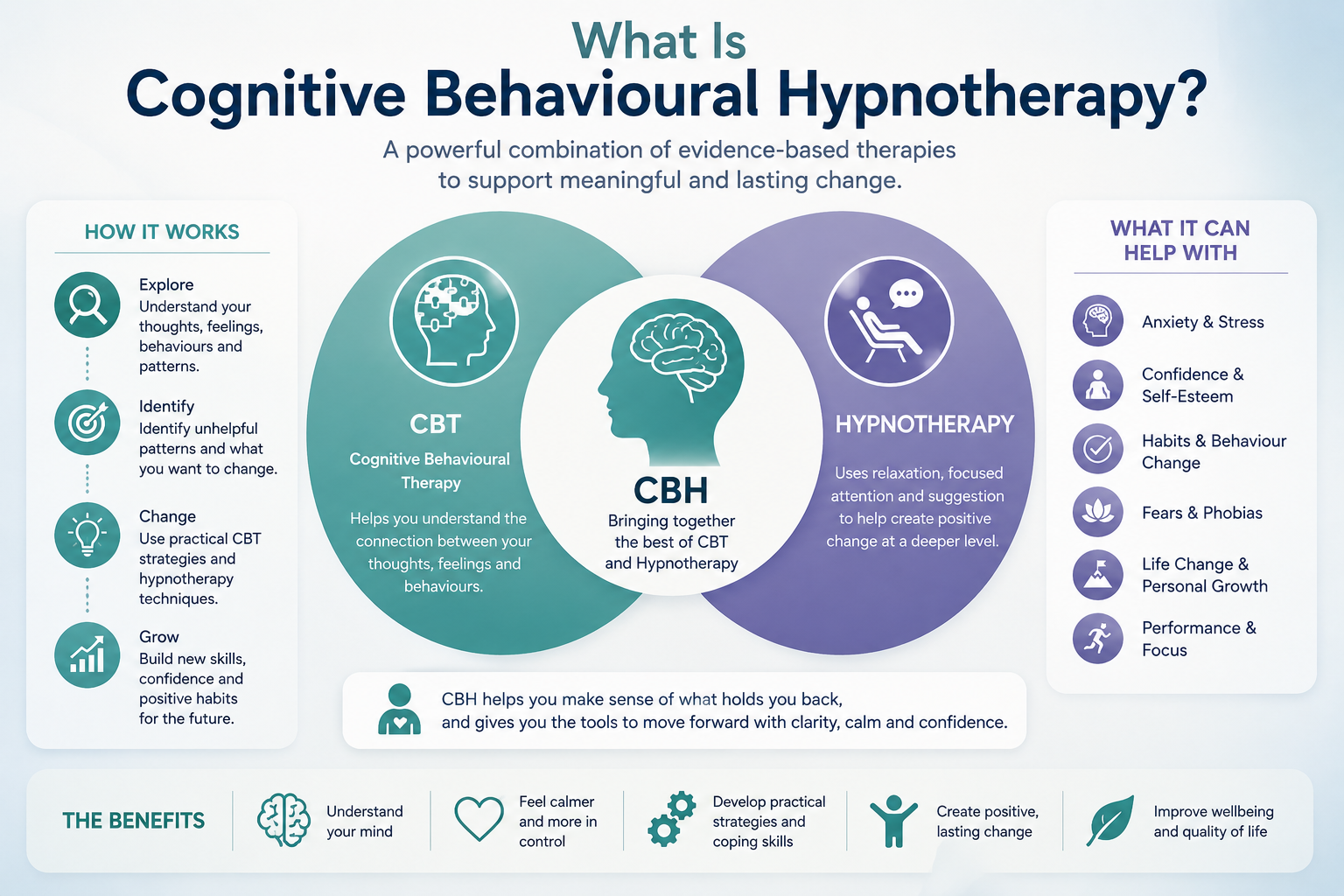
What Is Cognitive Behavioural Hypnotherapy?
Cognitive Behavioural Hypnotherapy, often called CBH, is a practical approach that combines ideas from Cognitive Behavioural Therapy with hypnosis, relaxation, focused attention, and mental imagery. It is designed to help people understand the connection between their thoughts, emotions, behaviours, and physical responses.
Many people think hypnosis means being unconscious or losing control. In Cognitive Behavioural Hypnotherapy, this is not the case. Hypnosis is usually understood as a focused state of attention where the mind becomes more absorbed, calm, and open to helpful suggestions. The person remains aware, in control, and able to respond throughout the session.
CBH is often used to support people with issues such as anxiety, stress, low confidence, habits, fears, overthinking, emotional regulation, and performance-related challenges. It can also be useful during life changes, when a person feels stuck or wants to develop a stronger mindset.
How does Cognitive Behavioural Hypnotherapy work?
CBH works by helping you notice the patterns that keep a problem going. For example, a person with anxiety may experience worrying thoughts, uncomfortable physical sensations, avoidance behaviours, and a fear that they cannot cope. These patterns can become automatic over time.
In a CBH session, the therapist may help the client identify unhelpful thoughts, challenge exaggerated fears, practise relaxation skills, and mentally rehearse new ways of responding. Hypnosis can be used to strengthen this process by making the practice feel more vivid, focused, and emotionally meaningful.
Instead of only talking about change, CBH often involves practising change. This may include breathing exercises, tension release, self-hypnosis, imagery, confidence-building suggestions, exposure work, and behavioural experiments.
CBH and anxiety
One of the most common reasons people look for hypnotherapy is anxiety. Anxiety can affect the body, thoughts, emotions, and behaviour. It may show up as racing thoughts, muscle tension, a tight chest, avoidance, overthinking, or a constant feeling that something bad might happen.
Cognitive Behavioural Hypnotherapy can help by teaching practical ways to calm the body, challenge catastrophic thinking, and gradually face situations that have been avoided. Hypnosis may also be used to mentally rehearse coping calmly in situations that usually trigger anxiety.
The aim is not to remove every uncomfortable feeling. The aim is to help the person build confidence in their ability to handle those feelings and respond differently.
CBH for confidence and life change
CBH can also be helpful for people going through life transitions. This may include changing career, returning to work, improving relationships, starting a new project, building confidence, or moving away from old habits.
When people feel stuck, it is often not because they lack ability. It may be because they have learned to expect failure, rejection, criticism, or discomfort. CBH can help explore these beliefs and replace them with more flexible, realistic, and helpful ways of thinking.
Through hypnosis and mental rehearsal, clients can practise how they want to act, speak, think, and feel in future situations. This can help build a stronger sense of confidence and direction.
CBH for sports performance
Sports performance is not only physical. Attention, confidence, emotional control, and mental rehearsal all play an important role. Cognitive Behavioural Hypnotherapy may support athletes or active individuals who want to improve focus, manage performance anxiety, recover confidence after setbacks, or prepare mentally for competition.
Hypnosis and imagery can be used to rehearse technique, strengthen motivation, reduce tension, and create a calmer performance mindset. CBH can also help challenge unhelpful thoughts such as “I always fail under pressure” or “I’m not good enough.”
The goal is to help the mind and body work together more effectively.
What happens in a CBH session?
A CBH session usually starts with a discussion about the issue, the client’s goals, and the patterns that may be keeping the problem going. The therapist may ask questions to understand how the client thinks, feels, and behaves in certain situations.
The session may then include practical exercises such as relaxation, hypnosis, imagery, self-hypnosis training, or cognitive techniques. The client may also be given something to practise between sessions, because progress usually depends on what happens outside the therapy room as well as inside it.
CBH is collaborative. The therapist does not “fix” the client. Instead, the therapist helps the client learn skills, practise new responses, and become more confident in managing their own mind and behaviour.
Is Cognitive Behavioural Hypnotherapy right for everyone?
CBH can be helpful for many people, but it is not suitable for every situation. It is not a replacement for medical care, emergency support, or specialist mental health treatment where that is needed.
A suitability call or initial consultation is often used to understand the issue, answer questions, and decide whether CBH may be appropriate. This is also a chance for the client to understand how the sessions work and whether they feel comfortable with the approach.
Final thoughts
Cognitive Behavioural Hypnotherapy is a practical and focused approach that helps people work with their thoughts, emotions, behaviours, and imagination. It can support change by combining clear psychological understanding with hypnosis, relaxation, and mental rehearsal.
Whether the goal is to reduce anxiety, improve confidence, manage stress, create life change, or support sports performance, CBH can offer useful tools for developing a calmer and more constructive mindset.
The aim is not to make people dependent on therapy, but to help them build skills they can continue using in everyday life.
Contact
hello@imaginariumtherapy.com
+1-708-858-0902 (U.S)
© 2026. All rights reserved.
+370 630 68015 (LTU)