
Meditation vs Hypnosis: What Is the Difference?
Meditation and hypnosis both use focus and awareness, but they are not the same. Learn the key differences, how each approach works, and how they may support anxiety, stress, confidence, and personal change.
Emilis Lasukas
5/18/2026
Meditation vs Hypnosis: What Is the Difference?
Meditation and hypnosis are often spoken about together because both involve focus, relaxation, and working with the mind. They can both help people become calmer, more aware, and more in control of their emotional responses. However, they are not exactly the same thing.
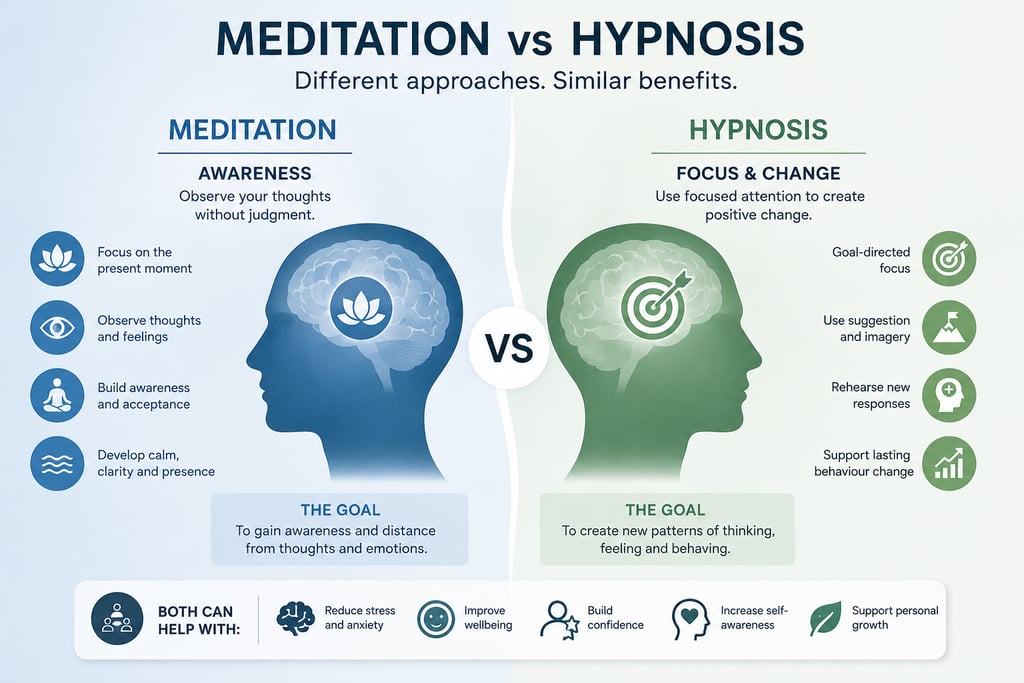
Meditation is usually about observing the mind. Hypnosis is usually about using focused attention to create change.
Both can be valuable, but they are used in slightly different ways.
What is meditation?
Meditation is a practice where you train your attention. This may involve focusing on the breath, noticing body sensations, observing thoughts, or becoming more present in the moment.
In meditation, the aim is often not to change your thoughts directly, but to notice them without getting caught up in them. For example, if an anxious thought appears, meditation teaches you to observe it as a mental event rather than automatically believing it or reacting to it.
Meditation can help with:
Anxiety and stress
Overthinking
Emotional regulation
Self-awareness
Relaxation
Feeling more present
A common meditation instruction might be:
Notice the thought, let it be there, and gently return your attention to the breath.
This helps build distance from thoughts and emotions.
What is hypnosis?
Hypnosis is also a focused state of attention, but it is usually more goal-directed. In hypnotherapy, the therapist may use relaxation, imagery, suggestion, and mental rehearsal to help a person respond differently to a problem.
You are not asleep, unconscious, or out of control. In therapeutic hypnosis, you remain aware and able to respond. The focus is on helping the mind become more absorbed in useful ideas, images, and new ways of thinking or behaving.
Hypnosis can help with:
Anxiety
Confidence
Habits
Phobias
Stress
Sports performance
Life change
Emotional wellbeing
A typical hypnosis exercise may involve imagining yourself coping calmly in a situation that normally feels difficult. This helps the mind and body rehearse a new response.
The main difference
The simplest way to understand the difference is this:
Meditation helps you observe your experience.
Hypnosis helps you guide your experience toward a specific goal.
Meditation often says:
Notice what is happening.
Hypnosis often says:
Imagine and rehearse how you want to respond.
Meditation develops awareness and acceptance. Hypnosis develops focus, suggestion, and change.
Example: Anxiety
If someone feels anxious before public speaking, meditation may help them notice anxious thoughts and body sensations without fighting them.
They might practise noticing:
“I am having the thought that I will embarrass myself.”
Instead of reacting automatically, they learn to step back and allow the feeling to pass.
Hypnosis, on the other hand, may involve mentally rehearsing the public speaking situation while feeling calmer and more confident. The person might imagine standing, breathing steadily, speaking clearly, and handling the situation well.
Both approaches can help anxiety, but they work in different ways.
Meditation builds a different relationship with anxiety.
Hypnosis rehearses a different response to anxiety.
Is hypnosis just deep meditation?
Not exactly.
Some hypnotic states can feel similar to meditation because both may involve calmness, absorption, and focused attention. But hypnosis does not have to be deeply relaxing. A person can be hypnotically focused while alert, active, and mentally engaged.
The key difference is the intention.
Meditation may focus on awareness.
Hypnosis usually focuses on therapeutic change.
For example, a meditation session may help you sit with discomfort. A hypnosis session may help you imagine coping with discomfort in a new way.
Can meditation and hypnosis work together?
Yes. Meditation and hypnosis can work very well together.
In Cognitive Behavioural Hypnotherapy, mindfulness-style awareness may be used to help a person notice thoughts and feelings more clearly. Hypnosis can then be used to practise new responses, strengthen confidence, or rehearse healthier behaviours.
For example, a person may first learn to notice anxious thoughts without automatically believing them. Then, through hypnosis, they may practise responding to those thoughts with calm, realistic coping statements.
This combination can be useful because it teaches both awareness and change.
Which one is better?
Neither is automatically better. It depends on what you need.
Meditation may be better if you want to:
Develop calm awareness
Reduce overthinking
Become more present
Learn to observe emotions without reacting
Build a regular self-practice
Hypnosis may be better if you want to:
Work toward a specific goal
Change a habit
Build confidence
Prepare for a future event
Reduce fear or avoidance
Improve performance
For many people, the best approach is not choosing one over the other, but using both in the right way.
Final thoughts
Meditation and hypnosis both use attention, imagination, and awareness, but they have different purposes.
Meditation helps you step back and observe your thoughts, feelings, and sensations. Hypnosis helps you use focused attention and imagination to create specific changes in how you think, feel, and behave.
If you struggle with anxiety, stress, confidence, habits, or life change, both approaches may be useful. Meditation can help you become less reactive, while hypnosis can help you mentally rehearse new patterns and build confidence in real-life situations.
The goal is not to escape your thoughts or control your mind perfectly. The goal is to develop a better relationship with your mind and learn practical ways to respond differently.
Contact
hello@imaginariumtherapy.com
+1-708-858-0902 (U.S)
© 2026. All rights reserved.
+370 630 68015 (LTU)